Wi-fi, fear-mongering, and pickles


Once again, I have to respond to a fallacious letter to the editor in my local paper, the Flamborough Review. And once again, it’s by the same guy. This is the third of his letters I’ve responded to; the first was about teachers and the second was about vaccination. Here is the letter in its entirety:

The  idea of  “learning commons” in children’s libraries is a noble idea, although I am not an advocate of this kind of technology in primary schools.

We are distancing our children so far from the fundamentals that they will no longer have a foundation to build on.

Reading, writing, arithmetic and spelling has gone the way of the dodo. As a parent I am concerned, as are many others, that technology is beginning to replace the fundamentals. I can see it in the work my daughter brings home, and the work she doesn’t bring home.

Another concern is the use of Wi-Fi in primary schools. Our children’s exposure to electromagnetic frequencies (EMF) is a cause for worry. According to Dr. David Carpenter, director of the Institute of Health and Environment at the University of Albany, there is a great body of work that shows continued exposure to EMF effects changes in the ability to learn and remember. Last fall, the World Health Organization could no longer afford to ignore the research and deemed EMF to be a Class 2 carcinogen. The list of Class 2 materials also includes items such as asbestos, lead and diesel fumes. I am certain I would not send my child to a room full of diesel fumes, so how can I consciously send her to a room full of harmful radiation?

In 2011, biologist Andrew Goldsworthy gave a witness statement to a standing committee on health regarding the dangers of EMF. One of the most horrific statements from his speech was, “it was first shown by Bawin et. al in the ‘70s that weak amplitude radio waves can remove calcium from brain cell membranes. This destabilizes them, making them more likely to leak. This is important in the brain because the normal function of brain cells depends on the controlled passage of specific ions through the membranes. When they leak, ions flow uncontrollably…When this occurs in a fetus or young child, it retards brain development…Wi-Fi should be considered an impediment rather than an aid to learning and should be avoided, especially by pregnant teachers.”

The very governments and agencies mandated to protect us allow this kind of harmful technology to exist. We need to reduce or eliminate our exposure to as many toxins as we can, for our own health, and that of our children.

There is a parents’ group in Collingwood trying to get Wi-Fi out of their schools, yet officials are siding with Health Canada, which is ignoring its own scientific data. Please go to safe school.ca and read up on this issue. Some of the evidenced side effects include nausea, headaches, dizziness, attention and focusing problems, low blood counts, disturbance of the immune system and heart palpitations and racing heartbeats.

I will be asking the Hamilton-Wentworth District School Board for the results of their testing to see what levels my child is being exposed to.

Kevin Inglehart, Lynden

My only comment on the opening bit about education is that my sons are in grades 9 and 6, all in the Hamilton public system, and they are certainly learning the fundamentals as well as technology. They certainly learn things differently than I did thirty years ago, but that’s to be expected. Perhaps this is a problem with the particular school or his daughter’s teacher. It could also be a problem with his expectations and not with the school board at all.

But onto the other issue he raises, that of wi-fi routers causing health problems. This time, I’m not going to write a letter to the editor in rebuttal of this. I’m going to write my rebuttal here rather than submitting it to the Review. Submitting it would require making it fit for general consumption, and so I’d have to refrain from the sarcasm and ridicule that I really feel like using. I’d also have to shorten it since I’ll probably write a lot here and the Review won’t print it if it’s too long. Quite honestly, I just can’t be bothered to clean it up and make it short. Writing concisely is much more difficult than just spouting off; in the words of Blaise Pascal, “I have made this [letter] longer, because I have not had the time to make it shorter.

So, to business. First off, the EM radiation given off by a wi-fi router is called “non-ionizing” radiation, which means that it’s not strong enough to remove electrons from atoms. This also means that it does not cause damage to cells. This is in contrast to ionizing forms of radiation, such as X-rays and UV rays, which do cause cell damage. Some forms of non-ionizing radiation (like microwaves) can heat things up and the heat can cause damage, but wi-fi signals are just not strong enough even for that.

It’s true that electromagnetic radiation is considered a class 2B carcinogen by the World Health Organization (WHO). All that means is that it’s on a list of things that have not been shown to be carcinogenic but require further study. Ken Foster, a professor of bioengineering at the University of Pennsylvania, says:

Saying that something is a ‘possible carcinogen’ is a bit like saying someone is a ‘possible shoplifter’ because he was in the store when the watch was stolen. [reference]

Here are some other things that are on the same “Class 2B carcinogen” list (the entire list is here):

  • coffee
  • asphalt
  • nickel
  • pickled vegetables
  • carpentry and joinery
  • chroloprene (also known as Neoprene, a synthetic rubber used in hundreds of products including clothing)
  • aloe vera
  • gingko biloba extract
  • talc-based body powder

Presumably Mr. Inglehart will be petitioning the school board to move the local Tim Horton’s further away from the schools, to remove wood shop entirely, and to ban pickles from student lunches.

Asbestos and diesel exhaust, which Mr. Inglehart claims are on the type 2 list, are actually type 1. (Diesel fuel is 2B.) Lead is on the 2B list, but lead is known for being a neurotoxin, not a carcinogen.

I did visit the web site Mr. Inglehart suggested, and found many anecdotes describing how people became sick when they installed wifi routers in their home or school. But as we all know (don’t we?), such anecdotes are scientifically meaningless. (One famous skeptical quote is “The plural of ‘anecdote’ is not ‘data’.”) There were also some studies that showed a possible association between cancer and cell phone towers – note that this is “possible association” not “proven causality”, and a cell phone tower is not the same thing as a wifi router.

It comes down to this: unless you are a biophysicist specializing in this kind of research, you have to read what others have done and then trust someone. I haven’t done the research myself, and I probably couldn’t understand the details of the studies if you put them in front of me. But I do trust the World Health Organization, who says (emphasis mine):

In the area of biological effects and medical applications of non-ionizing radiation approximately 25,000 articles have been published over the past 30 years. … Based on a recent in-depth review of the scientific literature, the WHO concluded that current evidence does not confirm the existence of any health consequences from exposure to low level electromagnetic fields. [reference]

The Ontario Agency for Health Protection and Promotion says

After a decade of additional research, there is still no conclusive evidence of adverse effects on health at exposure levels below current Canadian guidelines.

and

…there is no plausible evidence that would indicate current public exposures to Wi-Fi are causing adverse effects on health. [reference]

Just like a lot of other conspiracy theories, this one is based on bad data, bad assumptions, and mistrust of the scientific community. Then you wrap it all up with scary words like “carcinogen” and stories about people getting sick, and give it to parents while implying that if they don’t do anything about it, they obviously don’t care about their children’s health. If you do that, you might be able to convince parents that this is a real problem. That’s why we have school boards considering getting rid of wi-fi, not because it’s actually a problem.


I’ve seen a number of other letters to the Review from this same person. The majority of them are filled with fear-mongering and conspiracies like the “dangers” of vaccines and water fluoridation and that “banks and large corporations own and control the media“. Most of them are just opinions and have no references, but some of them, like this one, have references to one or two articles or scientists who happen to disagree with just about every other scientist in the world. It’s possible that he accidentally stumbled upon an article that describes the exact opposite of the scientific consensus and believed it wholeheartedly. But it seems unlikely that he’s done this several times, so I am forced to assume that he simply mistrusts science and government, and believes in any conspiracy theory he hears.

I find it partially amusing but mostly irritating that these conspiracy believers (and many alt-medicine believers too) are all “mainstream science is wrong” and “mainstream science is covering up the truth” until they find a scientist who supports them, and then they’re all “this person believes us and he’s a scientist so he knows what he’s talking about and you can trust him! And not all those other scientists! Just this one!” Sorry, folks, you can’t have it both ways. Either you trust the scientists (or more accurately, the science) or you don’t.


Update: I did end up writing a letter to the editor. Here it is:

I feel compelled to respond to Mr. Inglehart’s letter, which contains half-truths and misleading statements, so that other parents don’t concern themselves with a problem that does not exist. Wi-fi routers in our schools are not a cause for concern. There are certainly people who believe that they are, including a few scientists, but the vast majority of studies that have been done have shown no negative effects on health at all.

It’s true that electromagnetic radiation is considered a class 2B carcinogen by the World Health Organization (WHO). What that actually means is that it’s on a list of things that have not been shown to be carcinogenic but require further study. Other items on this list include coffee, asphalt, pickled vegetables, carpentry and joinery, aloe vera, and talc-based body powder. I don’t hear anyone leading the charge against wood shop or pickles in school lunches.

But if you’re going to believe the WHO’s “possible carcinogen” list, you should really believe the WHO when they say “In the area of biological effects and medical applications of non-ionizing radiation approximately 25,000 articles have been published over the past 30 years. … Based on a recent in-depth review of the scientific literature, the WHO concluded that current evidence does not confirm the existence of any health consequences from exposure to low level electromagnetic fields.”

More locally, the Ontario Agency for Health Protection and Promotion says “After a decade of additional research, there is still no conclusive evidence of adverse effects on health at exposure levels below current Canadian guidelines. …there is no plausible evidence that would indicate current public exposures to Wi-Fi are causing adverse effects on health.”

There is no point is spending more taxpayer money looking at something that has been studied this much when the overwhelming majority of the studies show the same thing – that there are no negative health effects caused by wi-fi signals.

Graeme Perrow
Waterdown

Northern Ontario 2013 – Part 1: Straits and Sleeping Giant


The Perrow Family summer vacation 2013 was a camping trip to Northern Ontario. “Hold on,” I hear you say, “you guys went to Northern Ontario last summer! I remember you writing about it!” Yes, dear loyal reader. You’re right: we did, and I did (parts one, two, and three). But last year the people we went to visit in Manitouwadge, Rolly and Candyce, were (gasp) living in sin and last winter, Rolly popped the big question. They decided to have the wedding this summer, and of course we were excited to make the trip back to the ‘Wadge (I don’t know if Manitouwadge residents really call it “the ‘Wadge”, but if they don’t, they should) for the festivities. Since this was the second wedding for both of them, they decided to forego the traditional wedding and do something different, and what could be more different than a Hallowe’en-themed wedding in August?

But we’ll get to the actual wedding later. As I have done with vacations in the past, I wrote in a mini-journal every night so I’d remember what we did, what we saw, and any other interesting facts that would likely get lost in the mists of time if I didn’t write them down. I do this so that once we return, I can write about them here, creating an online “web log” – a “blog”, if you will (I just coined that term now) – of our vacation.

We were away for two weeks, and stayed in four different places. I’ll write about the first two (Straits State Park and Sleeping Giant) in this article, and then the second two (Manitouwadge and Pancake Bay) in the next article. I’ve also created a Google map of our trip though it’s a bit hard to see since there was a lot of driving overlap, i.e. about half of the drive from Straits to Sleeping Giant was the same as most of the drive from Sleeping Giant to Manitouwadge, and the drive from Manitouwadge to Pancake Bay was entirely along roads we’d already travelled.

Aug 17

Driving Day One (of five). We left home around 9am and got to Sarnia a little over 2 hours later. After one of the quickest and most painless border crossings ever, we continued east from Port Huron to Flint where we stopped for gas. Then we hung a right and headed north to Straits State Park, just on the north side of the Mackinac1 Bridge.  The bridge is pretty impressive – 8 km (5 miles) long, and 200 feet above the water. They even have a free service where they will drive you across (in your car) if you’re uncomfortable driving across yourself. We arrived at the park around 4:00, got set up, and then had dinner.The Mackinac Bridge

We had a lot of fun on the way to Straits. We have a DVD player in the van so the boys brought movies, but Gail also got a couple of books on CD from the library. One of them, Dan Brown’s The Lost Symbol, turned out to be 35+ hours long so we didn’t listen to that, but the other was a classic: The Hitchhiker’s Guide to the Galaxy, read performed by Stephen Fry. I had read this book years ago, but forgot most of it. Fry did a great job with it, changing his voice or accent for the different characters – only slightly but enough that it was easy to figure out who was speaking. Obviously the book itself is hilarious, and we all enjoyed it. We got about 75% finished when we got to Straits, and then finished it a couple days later on Driving Day Two.

There are lots of restrictions on what kinds of food you can bring into the US, so we didn’t take any chances and brought very little that was suspect. The last thing we needed was to be stopped at the border and have to throw half our food out. All the meat we brought was still sealed in the original packaging, and we didn’t bring any eggs, milk, fruits, or veggies. After dinner, we headed over to the local grocery store to stock up on these supplies we didn’t bring. Going grocery shopping in a strange area is interesting; sounds dull but I really enjoy looking at all the differences from home:

  • Products we don’t have – various cereals and chocolate bars, aerosol cheese, pork rinds, strawberry marshmallows, Cherry Coke Zero (Dear Coca-Cola Canada: THIS. Thank you. Love, Graeme)
  • Packaging that’s different – Kraft Dinner is called Kraft Macaroni and Cheese, Knorr Sidekicks are called… something else, that kind of thing. Being from Canada, it’s also weird to see no French on any packaging.
  • Products that have the same name and packaging but are made differently – in Canada, Mike’s Hard Lemonade is a vodka cooler but in the US, it’s a “malt beverage”. Actually I think all coolers are malt beverages in the US. I don’t think there are malt beverages in Canada at all.
  • Being from Ontario, it’s weird to me to see alcohol on a grocery store shelf next to the bottled water, or beer in the cooler next to the cream cheese.

After shopping, we walked down to the beach, right on Lake Huron. The bridge is the dividing point between Lakes Huron and Michigan – this side of the bridge (the east side) is Lake Huron, and the other side of the bridge is Lake Michigan. From the beach, we got some great views of the Mackinac Bridge all lit up. We took a bunch of pictures (including the one above) and stargazed for a little while before heading back to the campsite. We were pretty tired and it was already getting late so we skipped the campfire and went straight to bed.

1 – The bridge and island are spelled Mackinac and the city is spelled Mackinaw, but they are all pronounced “MACK-in-aw”. It took Nicky a couple of days to stop saying “Mack-in-ack”.

Aug 18

Quick breakfast, then drove into nearby St. Ignace (pronounced IG-nuss) for the ferry ride to Mackinac Island. The ferry we took was called a “hydro-jet”, which meant that it had a rooster-tail of water shooting out the back. It actually did move pretty fast, and we specifically chose a time where they went under the Mackinac bridge as well.

Ferry with hydro-jetNo cars are allowed on Mackinac island. Later in the day, we did see one driving in the middle of the island somewhere, but it was an ambulance so we let them off the hook. We got off the ferry in a little downtown area, where we saw lots of little touristy shops as well as tons of bike rental places and horse-drawn taxis. There are lots of walking trails throughout the island, and we decided to take the one that goes all the way around the outside. We do a lot of walking on our vacations, so we figured we could handle the 8.2 mile perimeter trail. The trail was almost right on the edge of the water; usually there was only a rocky beach between the trail and the lake. In a number of places, previous visitors had made tall piles of rocks – similar to an inukshuk but just a single pile, some of them five feet tall or more. We saw hundreds of these things.

We stopped for lunch at the “world-famous” Cannonball grill (obviously you’ve heard of it, since it’s world-famous) for some pretty decent though overpriced burgers and dogs. (Three burgers, a hot dog, a couple of orders of fries and some drinks cost > $40.) After lunch we continued on our around-the-island trek but just over half-way around, we realized that we wouldn’t be able to finish it. We probably could have, except that we wouldn’t have seen anything else. There were a few things on the interior of the island that we wanted to see, and it would have been too far to walk into the middle of the island, see what we wanted to see, and then walk back to the outside. An 8 km hike is no big deal for us, but we were starting to realize at this point that 8 miles is not the same thing as 8 kilometers. 8 miles is more like 13 kilometers, and by now we knew that we were going to be pretty tired on the ferry ride back.

We headed for “Crack-in-the-island”, which Nicky wanted to see though we couldn’t find a description of what exactly that was. All we knew was the name, and that it was right next to “Cave in the woods” which Nicky also wanted to see. We did find it (the walking trails on the island are fairly well marked) but it was a bit underwhelming. Crack-in-the-island is just what it sounds like – a fissure in the ground, maybe 7 feet deep and 20 feet long. The boys actually walked through it and when they did so, they saw the cave in the woods, or so they think. There was no sign around saying what or where cave in the woods was, but there was a little cave (apparently not much more than an indentation in the wall) at the bottom of the crack, so we figured that was it.

Some battles during the War of 1812 were fought on Mackinac Island, and Ryan wanted to see the battlefields. When we got there, the “battlefields” turned out to be a couple of informational signs describing what used to be there, and the actual field itself was now part of a golf course. That was kind of on our way back to the south end of the island, so we didn’t really feel like we’d wasted a lot of time finding it. From there, we headed towards the Grand Hotel. This is when the GPS and Google Maps on my phone would have come in handy but it was not available. (The data rates when roaming to the US are insane a little too high for my liking, so I turned the mobile network off as soon as we entered the US and didn’t turn it back on until we were back in Ontario.)The Grand Hotel

We weaved through the town until we reached the hotel, which is absolutely magnificent. The balcony out front is massive, and the gardens are beautiful. Of course, I’m saying this based on the limited view we had and the pictures I’ve seen, not so much based on what I actually saw. I’ve never before seen a hotel that charged admission just to walk around, but this one does. If you are not a registered guest, it costs you $10 (half price for kids under 12!) just to get onto the grounds. It would have been $35 for the four of us, which we were not willing to pay, so we took some pictures from the road and decided that that would do. The only part of the building that you’re allowed in without paying the admission is the ice cream shop, so we took advantage of that.

At the time, we assumed the place was expensive but had no idea how much it would be to stay there. Once we arrived home, I did some quick research. For the cheapest room during the cheapest time of the week, it would be $264 per night. Per person. And that’s just for two of us. For extra people in the same room, it would be $59 for Ryan and Nicky would be free, so a single night would cost us, once you factored in the taxes and “Mackinac Island assessment” and luggage fees, about $786. For one night. Now, that includes both dinner and breakfast, so there’s that. But still.

We continued through the cute little town back to the docks, and caught the 5:30 ferry back to St. Ignace. Despite not finishing the 8 mile walk around the island, we figured that we’d walked at least 8 or 9 miles anyway, or 13-14 km, so we were tired and hungry. We decided that cooking dinner would take too long, so we asked one of the guys on the dock if he knew of a good place to get a pizza to go. He pointed us to a place across the street called Pizza Builders. We got a couple of pizzas to take back to the camp site and enjoyed them thoroughly. After a campfire and some obligatory marshmallows, we all went to bed.

Aug 19

We slept in a bit today and enjoyed a full pancakes-and-bacon breakfast before having showers. Once we were all refreshed, we took a drive back over the Mackinac bridge into Mackinaw City, stopping at Colonial Michilimackinac Park, where we took 10 or 15 minutes to learn how to say the name of the place (MISH-ill-uh-MACK-in-naw). We had been to Fort William in Thunder Bay last summer, and we figured this would be very similar to that so we didn’t actually go in, just stopped to pick up some of those touristy brochures for other things to see. We were headed for a place called Mill Creek, and figured it would be half a day so we were looking for somewhere else to go once we were done there. Turns out we needn’t have bothered.

Historic Mill Creek Discovery Park is the site of a two-hundred-year-old sawmill which was in use for years but subsequently destroyed. It has been painstakingly recreated in every detail, and there are regular demonstrations of how it helped transform the logging industry. Sawing logs into long boards used to be a slow and very labour-intensive procedure – a single board might take an hour to cut, and they’d get 12 of them cut a day. Once they built the mill, no manual labour was necessary and a board could be cut every 7 minutes. The show was really interesting and the guy who did it was very knowledgeable and entertaining.

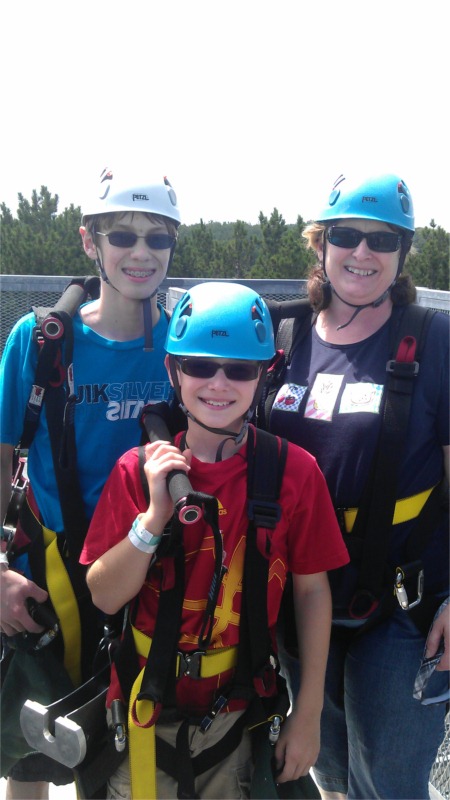
Boys on the climbing wallThere was also an “adventure tour” which we enjoyed. It started with a short nature hike with a guide who pointed out local flora and told us about local fauna, not that we saw any fauna. In fact, I don’t think we saw so much as a squirrel or chipmunk at our campsite, on Mackinac Island, or at Mill Creek. A few birds, but that’s about it. That would change later in the trip (foreshadowing!). In the middle of the hike was a bridge made primarily of ropes and wires, but with a narrow wooden floor to walk across. The views from here were pretty nice, and despite being 50 feet up, the bridge felt strong and we were also attached with wires to cables above the bridge so we felt secure. After a bit more of a hike (the hikes on this tour were maybe 1km total), we got to the zip line. This was nowhere near as long as the one at Horseshoe Adventure Park, but still a lot of fun. After zipping over the river, we went around the corner to the 40-foot climbing wall, which Gail and I passed on but the boys enjoyed. Both made it to the top without any trouble.

There were some walking trails through the forest, and we never pass up a good walking trail. They were only a few km as well so it was nothing like the walking on Mackinac Island, but we got some good views of the beaver dams in the river (but we didn’t see any beavers). We ended up spending the rest of the day at Mill Creek and thoroughly enjoyed it all. The whole place was clean and very well kept. The place was quite inexpensive too – admission was $4.75/person and the adventure tour was another $8/person. My only complaint was that there was no food available other than some ice cream, small snacks, and drinks in the gift shop. A place to buy overpriced burgers and dogs would be a good addition. We had brought our own sandwiches, veggies, and drinks for lunch anyway so we were fine.

We headed north again to our campsite (trip #3 over the Mackinac Bridge – total tolls for the 3 trips: $20) for dinner, a campfire, and bed.

Aug 20

Driving Day Two. We packed up quickly and left Straits about 8:45am, heading north. After another very quick customs stop (this is not always the case, so we got really lucky twice on this trip) at Sault Ste. Marie, we stopped at the Sault KOA for a quick visit with John and Jackie (Gail’s dad and stepmom) who were camping there on their way to Manitouwadge. We only stayed a half hour or so since we still had over 700 km still to drive. We finished the Hitchhiker’s Guide, and the boys watched The Dark Knight and then the first half of Batman Begins. Yes, in that order, and no, they didn’t even bring The Dark Knight Rises. They do that. I don’t get it either.

We stopped for lunch at Krazy Fries (a chip wagon) in Wawa, where we also got gas. (Old joke.) After another gas[oline] stop in Nipigon, we finally ended our 11-hour driving day at Sleeping Giant Provincial Park around 8pm. For this part of the trip, we were camping with Jackie’s daughter Sandy and her 17-year-old daughter Alison, who had already arrived. While we were getting set up, Ryan and Alison went for a  short walk (that turned into a long walk because they got lost) and saw the first fauna of our trip: four deer walking through the campground.

The Sleeping Giant is a huge rock formation that is clearly visible from the city of Thunder Bay, and looks somewhat like a man lying on his back. We saw the Sleeping Giant from Thunder Bay last summer, and I was hoping we could get to these rocks and climb them, getting a view of Thunder Bay from the Giant. No such luck though, as the cliffs that make up the Giant are a 22 km hike from the campground, and there are no roads that go there. It’s not an easy 22km walk either, it’s recommended that you take provisions for a night or two and you should be an experienced overnight hiker. So we had to make do with the great views of the Giant from the beach, which was a two minute walk from our camp site.

Aug 21

Our first day at Sleeping Giant was a little more laid back than our days at Straits. In the morning, we played some cards and did some reading. Sleeping Giant more than made up for our lack of wildlife sightings at Straits; there were chipmunks all over the place. They were tame too – they’d take peanuts right out of our hands.

Nicky made a friendAlison and her friend

After lunch we headed over to a walking trail, of which this park has many. The one we chose was called the Wildlife Habitat trail, and I believe it was designed so that wildlife would be drawn to that area. The trail was very nice but for viewing wildlife, we should have stayed at our site. We saw a few birds and one butterfly, but that was about it. The visitor’s centre had a map that listed recent wildlife sightings, which over the last month or so had included wolves, bears, deer, various kinds of birds including cranes and herons, and various others. The hike was only a couple of kilometers so it didn’t take long. After the hike, we returned to our site for more card games. I alternately read and napped for a while.

We barbecued steak and potatoes for dinner, and just as we were finishing up, Gail suddenly gasped and pointed out towards the road behind our site. Walking across the road was a deer. We thought the chipmunks were cool, but this more than made up for any lack of wildlife sightings at Straits. I grabbed my phone and took a few pictures. In this one, you can see Nicky behind the deer.

Mama deer

After she moved off a bit to my left, I went up the road to try to get a better picture, and that’s when I saw the others – two baby deer, covered with white spots, playing on the next road over. They jumped around each other a few times and NIcky and I just stared in awe at these beautiful and majestic creatures before they bounded with amazing speed into the forest. This was our third trip to Northern Ontario and we’d never really seen much wildlife on previous trips, so this was certainly a highlight. But we weren’t done with the wildlife on this trip. (More foreshadowing!)

Baby deer

Aug 22

After a lovely breakfast of French toast (my wife is awesome), the boys and I borrowed Sandy’s canoe and went paddling on Marie Louise Lake. We only had two paddles so Nicky got a free ride in the middle, but Ryan was in the back (the steering position) and was proud to show off his skills. The beach is on a little bay at the south end of the lake, and we were going to do a tour of the lake. But when we went around the point, we found that the lake was far bigger than we originally thought so we killed that idea and just stayed in the bay.

After lunch, we went on a couple of other nature hikes. The first was called Sea Lion, but not because there are sea lions living there. There is a rock formation visible from part of the trail that apparently looked like a sea lion at one point, though the head fell off about a hundred years ago. Now it just looks like a stone arch. The total of the wildlife on this trail was a garter snake that Ryan saw. We got some great views of Lake Superior though, and were able to walk down right by the lake. Gail likes to walk on beaches with her feet in the water, but there was no way that was happening here, the water was just too cold. This trail continued on for another 10 km or so, and then joined other trails that went all the way to the Sleeping Giant itself, but we weren’t up for a hike that long so we turned back.

Once we finished that trail, we took another one called Ravine Lake. This was a loop that included a climb to the top of some cliffs where we got more great views of Lake Superior as well as Ravine Lake. Each of these trails was just a couple of kilometres, but the Ravine Lake one was quite hilly so by the time we were done, we were done, and we went back to camp for dinner. After dinner, the boys and I went on another canoe trip (our legs were still tired from the hikes but no leg muscles are needed for canoeing), then some desperately needed showers before campfire and bed.

At one point during this day (I think it was after dinner but I don’t remember exactly), we saw movement on the other side of the trailer. I assumed it was one of the many chipmunks that visited us during our stay, but then saw that it was much bigger than a chipmunk. It turned out to be a very cute little skunk. Of course, a skunk isn’t the kind of animal that you try to pet or toss peanuts at, and while it was wandering around our site, nobody moved. We weren’t afraid of the animal, just afraid that we’d spook it. We all know what could happen if a skunk gets spooked. I was standing near the open tailgate of the van and our visitor strolled nearby as well and actually went under the van for a short time. I very casually took a couple of steps to my right and closed the tailgate; the last thing we wanted – well, the last thing we wanted was to get sprayed. But the second last thing we wanted was to have the skunk jump into the back of the van and either steal some food or find a soft place to have a nap. It turned out to be fine; Mr. LePew just kept on walking across the road and we didn’t see him again. Gail thought she smelled something the next morning though – something must have made him unhappy.


The next day we left for Manitouwadge. The story continues in the next article.

Literally: Making stupid people correct rather than correcting stupid people


You may have already seen this, but if you do a Google search for the word “literally”, it comes up with the following definitions: literally

Note the second one, which was apparently added back in 2011 though nobody really noticed it until recently. I see it all the time in the sports world; a player will play very well for a few games in a row and people say he’s “literally on fire”. I’ve heard people saying that someone “literally took the bull by the horns” or something they didn’t like “literally drove me crazy”. Up to now, this has simply been wrong. Now, apparently, it’s not.

At the risk of being (correctly) labeled a “grammar Nazi”, the misuse of this word has been (figuratively) driving me crazy for years. Language changes and evolves, I get that. The sentence “My cell’s out of juice so I can’t tweet” would have made no sense thirty years ago. These kids today People younger than myself use the word “sick” to describe something good, but that’s slang and was likely done intentionally for ironic effect.

This is not the same as giving a word (cell, tweet) a new meaning for which no word previously existed, or using a word ironically. In this case, people who don’t know what the word means are incorrectly using it to mean precisely the opposite of what it actually means, and now we’re saying that’s OK. We are catering to the seemingly increasing number of ignorant people. Rather than teaching people the correct meaning of the word and correcting those who misuse it, we are just making it right so that there’s no problem.

We are dumbing down the language.

If this continues, here are some other words that will be added to the dictionary sometime soon:

Prolly: (adv.) Probably. As in “I’ll be there late in the morning, prolly around ten-thirty.”

There: (adv.) Synonym for “they are” (formerly “they’re”) or “belonging to them” (formerly “their”). As in “They can’t remember where they parked, so there looking for there car over there.” Much easier to have just one word since people use them interchangeably anyway. Similarly, “its” vs. “it’s”.

Alot: (n.) A lot. Alot of people use this word, not knowing that it does not exist. But it doesn’t need to make you unhappy.

Ignorant: (adj.) Rude. It actually means “without knowledge”, as in “I am ignorant of the rules of cricket.” But if someone cuts in line in front of you at the grocery store, that’s rude, not ignorant.

planet

I am Two-Face to Maynard James Keenan’s Joker


Last week, I bought a few music CDs. Like, CDs with music already on them. And not MP3s. I know, totally old school, but I’m an old school kind of guy. Anyway, a couple of them were from a band called A Perfect Circle which features Maynard James Keenan, the lead singer of Tool. I had never heard any music by this band, but I like Tool and Keenan has a distinctive and strong voice so I took a chance. But the band isn’t what this is about.

A Perfect Circle - Thirteenth StepThe CDs I got were their first and second albums Mer de Noms and Thirteenth Step. On the back of the Thirteenth Step CD case, it says “Copy Controlled”, which I assumed was some technology to prevent people from making copies of the disk. It never occurred to me that this would prevent the tracks on the disk from being ripped by programs like iTunes, because everyone uses iTunes or Windows Media Player or something like that, right? I mean, considering the number of iPods and other MP3 players out there (recent surveys say there are approximately 4.23 gazillion of them), no record company in their right mind would knowingly put technology on an audio CD that prevented it from being imported into iTunes. Would they? Yes. Yes, they would.

(Note that I’m giving the record companies the benefit of the doubt here. It’s possible that they’ve done this so that people who wanted MP3 copies would be forced to buy the album twice. I’m going to assume that the copy protection is there solely to prevent piracy and not as a way to rip off consumers.)

Neither iTunes nor Windows Media Player can read the disk at all. I can’t even play the disk on my computer. So now I have an audio CD that I legally own and yet I cannot listen to it on my computer or iPod. If I’m in the car, I could use the CD there (if it works on that player), but that means either leaving it in the car all the time or deciding in advance what music I’m going to listen to when driving. That’s a pain, and avoiding that is the reason I bought an iPod in the first place. I sometimes listen to music at work through my iPod, but this album would be unavailable. The other A Perfect Circle album rips and plays fine. Keenan’s voice is obviously a big part of it, but the songs are shorter than Tool, and a little more mainstream. There is far less ambient stuff – one of the songs on Undertow (a Tool album I also bought) (and successfully ripped) contains almost ten minutes of near-silence. But the band isn’t what this is about.

So what are my alternatives? I’ve searched the internet and have found some instructions on how to rip such CDs, so I may try one of those. I could just buy the album digitally, but that means paying for it twice and since I haven’t even been able to listen to it yet, I’m a little reluctant to pay again. But there’s another alternative.

I could steal it.

Music pirate

I could probably search the internet and find an illegal copy of the album someplace and download it in ten minutes. Make no mistake, I realize that this is theft, but I already paid for the album, so the band / record company is not really losing out on anything if I download it. At least, I could use that logic to justify it to myself. But I’m not a music pirate.

I work in the software industry. The software package I work on is not a huge piracy target, but the concept is clear – people downloading SQL Anywhere and not paying for it are stealing from my company. Similarly, downloading A Perfect Circle would be stealing from the record company and, indirectly, the band members themselves.

I’m also a little gun-shy. A few years ago, I downloaded some torrents of TV shows (just episodes I missed of CSI or something from network TV, not PPV or anything), and I got an email from my ISP saying “we’ve been told that you’re downloading copyrighted material. You’d better stop.” I did stop, and so if I decide to look for A Perfect Circle’s album online, I’m a little concerned that I’ll get caught and they’ll cut off my internet.

So integrity and fear means that I probably won’t steal it. If the methods I’ve found of ripping the CD don’t work, I’ll probably just buy the damn thing online. I’ll grumble and I’ll complain, but I’ll fork over the $10. And I’ll probably buy their third album as well. But the thought of downloading a pirated copy of the album did cross my mind, and not just for a few seconds. I seriously considered it.

The record industry is trying to prevent piracy, but the method they’ve chosen (this type of copy protection) is making a non-pirate like me consider stealing the album. They have taken a law-abiding citizen who is against piracy and turned him into a potential criminal.

Talk about unintended consequences.

Toxic thinking


I’ve been seeing more and more articles and blog postings like this one recently, all about “detoxifying” your home or your life or your body. They all talk about these vague “toxins” generally but never say what toxins. Then they talk about some of the dangers to society and how to either avoid or fix them but most of the time, the “dangers” aren’t actually dangerous and the “solutions” are either non-existent, ineffective because they don’t work, or ineffective because there’s no problem to solve in the first place.

The author of this story has a son who was diagnosed with autism and says that our “toxic” environment is the cause for her son’s illness. (Somewhat surprisingly, she makes no mention of vaccines.) She then describes ways to “de-toxify” your life. She certainly makes some good points in the article – drink water instead of other stuff, eat lots of fresh fruits and vegetables, avoid processed snacks, eat rice crackers or veggie chips, go to farmers markets, these are all great suggestions. But here are some of the points she makes that directly contradict modern science and medicine:

The world in which our children are currently growing up, is significantly more toxic than the one in which we did as children, exponentially more so than our parents.

Really? How do you figure? We and our parents lived through lead (in the pipes, paint, toys, etc.), asbestos, DDT, Thalidomide, and other actual toxins, all of which are now known to cause no end of health problems. Specifically what toxins are you talking about that are significantly or exponentially worse than those?

organic_comic

We know organic is best. Food dyes and colors make our kids wild. GMOs are terrifying. Gluten, soy, corn, and dairy are the high allergens and can cause all sorts of issues. Juice is unnecessary sugar and calories.

Nope, probably not, nope, nope (provisionally), OK. Organic food is no healthier or safer than non-organic (See references 1, 2). I did read about a study that food dyes may cause hyperactivity in children, but the FDA in the US has thus far declared that “a causal relationship between exposure to color additives and hyperactivity in children in the general population has not been established” (3). GMO food is no less healthy or safe than non-GMO (4). If you have Celiac disease, gluten is certainly something you want to avoid. But if you don’t, it’s harmless (5). Soy, corn, and dairy are indeed allergens and can cause all kinds of problems if you are allergic. But I could find no articles indicating that they’re a problem if you are not allergic. (6). The juice one I’d agree with.

Allopathic medicine is a term coined by Samuel Hahnemann, the father of Homeopathy, in reference to ‘mainstream Western medicine’. In simple terms, it refers to our constant need to address and suppress every symptom our body sends us of illness.

“Western medicine just treats the symptoms” is a common misconception in the alternative medicine community. If that were true, doctors wouldn’t prescribe antibiotics for pneumonia, they’d just give you a cough suppressant. If you have pain because of appendicitis, do they treat the pain? No, they remove the appendix – that’s treating the cause, not the symptom. I recently heard Dr. Steven Novella (a neurologist and prof at the Yale School of Medicine) talking about this, and he said that other than managing the pain of terminal patients to make them comfortable, so-called “Western” medicine is entirely about treating the cause of health problems and not just the symptoms. So is alternative medicine, but the two just disagree on how to determine the causes. Western medicine uses science, alternative medicine uses magic.

I had severe acute pancreatitis a few years ago and spent two months in the hospital. One of my biggest symptoms was intense pain, caused by my pancreas effectively choking on a gallstone. Did the doctors treat my pain? Of course they did. They also performed major abdominal surgery, an MRI, several X-rays and ultrasounds, countless CT scans and a number of other procedures to deal with the cause of this condition, not just the pain. Three years later, except for being a type 2 diabetic I am fully back to normal, and I owe my life to those doctors and nurses. How would an acupuncturist deal with pancreatitis? They wouldn’t – they’d either (a) send you to a hospital because they know they can do nothing, or (b) ironically attempt to treat the pain and not the cause, thereby killing you.

The author says that fever is our body’s natural reaction to an infection (true) and that we shouldn’t attempt to reduce the fever because of that. But then a couple of paragraphs later, she says we should use “good old fashioned ‘grandmas recipes’… like placing the soles of the feet in water for a fever”. Didn’t she just say we should not try to reduce fever?

Look to Homeopathy. … Or find a local homeopath to work with, Queen Elizabeth does!

Not only has homeopathy never been proven effective, it’s actually harmful to those who would use it instead of seeing a real doctor and getting real medication (7). In fact, there is no known mechanism by which it could be effective.  It’s nothing but water or a sugar pill – the very definition of placebo. The fact that Queen Elizabeth has been duped into using homeopathy means nothing.

And finally EMF. Electromagnetic Fields. We live in a world of wireless. There are frequencies from our cell phones, internet connections, microwaves, smart TVs, etc, all around us and our cells are not accustomed to that. The damage is not yet fully known.

Tin foil hatElectromagnetic sensitivity has repeatedly been shown to be nonexistent. People who claim that they are negatively affected by electromagnetic fields consistently show symptoms until proper blinding is added. When they don’t already know whether they are being exposed or not, they can’t tell. (8, 9)

The article then links to a couple of web sites that sell products that are supposed to help people with EMF sensitivity. Since EMF sensitivity doesn’t exist, these products can’t work, and some of the claims they make are ridiculous. But that doesn’t stop these people from charging $89 for something that “protects you from cell phone radiation”,  between $310 and $380 for a plate that “clears EMF pollution and geopathic stress”, and even $160 for the ultimate in irony: a USB thingy that uses your wifi router to somehow broadcast EMF protection.


These kind of articles frustrate me to no end, because the more articles like this there are, the more likely people are to read them and believe them. Science and modern “Western” medicine has given us the world we live in today – people are healthier now than ever before, life spans are longer, fewer people are dying of hunger, and so on. We haven’t solved all the problems – people do still die of hunger and there are still many diseases that science has not yet found answers for – but the human average lifespan has more than doubled since 1900 and that’s due to science, not to people harmonizing their life energy field with that of the earth.

The entire goal of science is and has always been to advance human knowledge. So why is it that so many people are now rejecting science and getting their health information from whoever on the internet? They ignore just about every doctor in the world and listen to Jenny McCarthy when it comes to vaccines. They believe that anything “all-natural” must be healthier than anything that’s not (as I’ve said before, e. coli and salmonella are all-natural, while Tylenol is not). They read Natural News and believe the guy who tries to convince the world (without evidence) that the entire healthcare and pharmaceutical industries worldwide are global conspiracies and that millions of people wouldn’t die of cancer every year if they just listened to him.

The worst part is that it’s not just the cranks and tinfoil-hat people who believe this stuff – the general public seems to think that GMO food will kill us all and that obviously organic food is healthier than non-organic. What happens if some company uses genetic modification to create a type of wheat or rice or corn or whatever that is resistant to diseases and has extra nutrients and can be stored for longer without going bad and allows farms to increase their yield tenfold? Note that this is not outside the realm of possibility – these kinds of things are why we do genetic manipulation in the first place. Crops like this could solve much of the world’s hunger problems (and yes I know that’s a little simplistic) but if enough people are scared of GMO food, it may not matter because the research will get shut down before we get there. That’s really sad.

I can only hope that sometime in the not-too-distant future, people start embracing science once again and abandoning things like medicine based on magic or remedies that are popular only because they were used in China a few thousand years ago or fear of things just because they are not well understood. Let’s start moving human knowledge forwards again, not pushing it backwards.

References

Unlike the original article, I am including references for all the claims I’ve made here.

  1. The American Journal of Clinical Nutrition
  2. The Annals of Internal Medicine, produced by the American College of Physicians
  3. An FDA quote from CBS Chicago
  4. The World Health Organization. You may disagree with the business practices and policies of GMO companies like Monsanto, but that’s a problem with the companies, not the GMO food itself.
  5. The Journal of the Academy of Nutrition and Dietetics
  6. No references here, because I couldn’t find any from reliable science-based medicine sites talking about corn or soy problems or dairy problems that weren’t related to lactose-intolerance. But bullshit sites like Natural News were filled with articles saying dairy is universally harmful, which implies to me that it’s not.
  7. The Journal of Medical Ethics
  8. Psychosomatic Medicine, from the Journal of Biobehavioral Medicine
  9. The World Health Organization

Horseshoe Adventure Park


Horseshoe Valley is one of the most popular skiing destinations in Ontario. But if you have a hotel that’s full all winter and empty all summer, what do you do? Easy – you set up some stuff to do in the summer, and that’s what the Horseshoe Valley people decided to do. They created Horseshoe Adventure Park and gave people a reason to come out in the summer as well. Last week, we spent my birthday there and had a fantastic day, even if the original reason we were going was not even available.

A few years ago, we started a new Christmas tradition. Each of the four of us would come up with something that we wanted to do (some sort of outing), and make up a poster about it. Then after Christmas, we’d schedule these outings throughout the year. The only rules were that it had to be less than $200 (or at least close), and it had to be close enough to make it a day trip. The first year we went snowboarding, to an aquarium in Niagara Falls, and canoeing on the Grand River near Paris. (We only did three because Gail and I coincidentally both chose canoeing.) Since then we’ve been to another aquarium, the HMCS Haida in Hamilton, a butterfly conservatory, and skating at Nathan Phillips Square.

This past Christmas, Nicky’s poster was for Horseshoe Adventure Park, which had a thing called Aqua Ogo which he was dying to do. In a nutshell, the Aqua Ogo is a big rubber ball with water in it. Two people get in the ball and then you are pushed down a hill. Here’s a video of Rick Mercer at the park riding motorbikes (which I don’t remember seeing) and the Aqua Ogo. Nicky thought this would be the greatest thing ever (and it does look like fun) and so we planned on going sometime over the summer. When Gail found a WagJag coupon to get us in at half-price, that made it even better. We ended up going on my birthday just because it was a convenient day rather than a birthday present for me.

But a couple of weeks before we went, Gail got an email from WagJag saying that the Aqua Ogo (which was included in the package we bought) had been shut down until further notice. No further details were given, but we assumed that someone had gotten injured and the ride was shut down until (a) any pending lawsuits were settled, and/or (b) the safety of the ride was improved. Nicky was pretty disappointed, but we decided to go to the park anyway.

The other major attraction was the zip line, billed as the fastest in Ontario. This was a blast. I’m not always Mr. Thrill Seeker, in that I’m too chicken nervous to bungee jump or skydive or things like that (I don’t even do tall roller coasters), and I have to admit I was a little concerned at the top of the tower that I would be terrified the whole way down. Some people find being terrified exhilarating. Not me. But no more than a few feet down the line, I realized that this was going to be fun. It went fast enough to make it fun but not so fast that I felt out of control – not that there were any brakes or any way to get control should I have needed to. Nicky and I went at the same time and as I pointed out to him at the end, I totally dusted him – without even trying. (Thanks, gravity.) Gail’s as much of a thrill seeker as I am, but she loved it as well. And thanks to the closure of the Aqua Ogo, three of us got to go a second time.

After the zip line, we wanted to try another thing called Treetop Trekking, which was basically a high ropes course through the trees. This looked fun as well, but after we filled in the waiver forms we found that reservations were strongly recommended, and we didn’t have one. Since they were fully booked for the rest of the day, we were out of luck. We had no idea that we needed to make reservations so we missed out entirely on this part of the park. Dear WagJag / Horseshoe Valley: you really should add that into the description of the attraction. The Horseshoe web site makes that clear, but the WagJag thing did not.

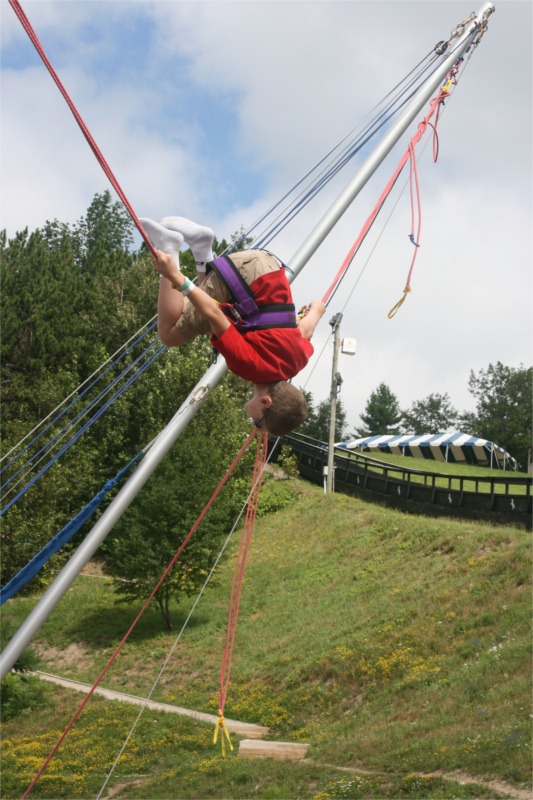
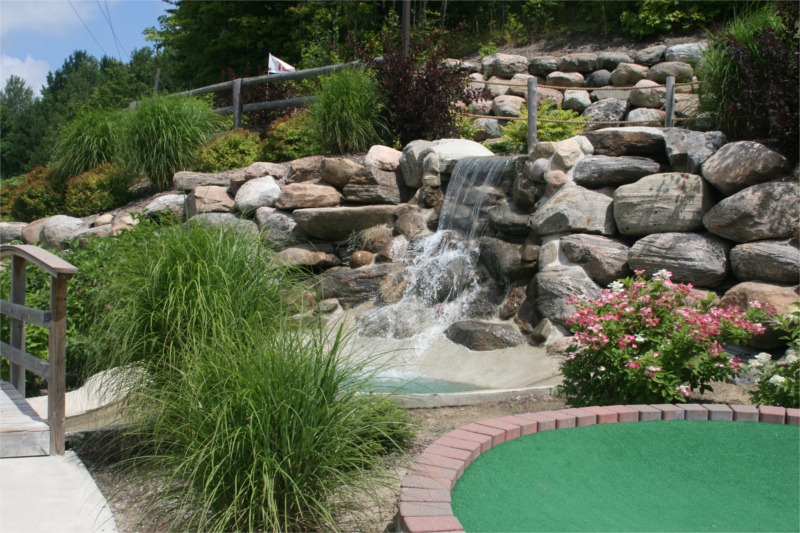
But this place had even more to do. There is a beautiful mini golf course built into the side of a hill. It was well-designed and well-built and had nice waterfalls and wooden fences and gardens throughout. There is a big rock-climbing wall though the boys didn’t have a chance to try it. There’s a “Euro Bungy” thing, with trampolines and bungee cords that bounce you 10+ feet in the air. There’s a big maze which is fairly easy once you figure out the secret (both boys timed themselves getting through it after they figured it out – 50 seconds for Ryan, 49 seconds for Nicky) but until then, it’s tougher than it looks and a lot of fun.

I mentioned earlier that three of us got to do the zip line twice. We each got a ticket as part of our package deal, and because the Aqua Ogo was closed, we all got the option of either a second zip line ticket or a “mining” bag, which was a bag of dirt containing small gem stones. Gail wasn’t sure she was going to want to go on the zip line twice and Nicky loves to collect rocks so Gail chose the dirt (and then Nicky walked around all day paraphrasing Captain Jack Sparrow – “I’ve got a bag o’ dirt!”). Turned out that she enjoyed the zip line enough that she could have gone again, but we had some fun using a sluice to filter out the rocks from the dirt and got a little collection of chunks of topaz, amethyst, and obsidian. The last thing we did before we had to leave was Archery Tag, which is just what it sounds like. You get a bow and some arrows, and you try to hit other people to knock them out of the game. This sounds like just about the least safe activity you can imagine, but everyone is wearing a helmet with a full face mask, and the arrows have a big cushiony thing at the point that looks like a marshmallow. This not only cushions the impact so it doesn’t hurt but it slows the arrow down significantly – enough that Ryan was able to catch one out of the air. For a while it was just me against Nicky and Ryan (with photographer Gail covering from the sidelines), and then another family joined so it was the three of us against the four of them. They were clearly more skilled at this sport than we were, since I was knocked out less than a minute into the game, and by the time the game had ended, they had knocked Nicky and finally Ryan out as well while we took out none of them. This was also a lot of fun, though I felt a little weird shooting arrows at my kids.

This isn’t the cheapest place around, but it’s not outrageous either. The package we bought would have cost us $25 each plus another $45 for three extra zip line rides. The WagJag was about $50 for the four of us and that included the extra zip line rides (and the bag o’ dirt) because of the Aqua Ogo closure. There was your standard snack bar / chip wagon, and I believe there’s a full restaurant in the hotel though we never went in there. There was even a big pavilion for some shade and lots of picnic tables around. We had a ton of fun and Gail will be scouring WagJag for a similar deal so we can go back next summer. Truth be told, we had enough fun that we’ll probably go even if we can’t find a deal, but don’t tell the Horseshoe people that.

More pictures:

Zip line View from the top of the zip line. You can just see Ryan on his way down.
Zip line - Ryan Ryan going hands-free
Zip line - Graeme Graeme going hands-free
Zip line - Nicky Nicky didn’t get the hands-free memo and is having more fun that it appears
Archery - Ryan Ryan showing fine form
Archery - Nicky Nicky prefers the crossbow stance
Maze The maze

Give up telling people about Facebook hoaxes? Done.


Yet another “Facebook is making all your data public!” hoax is making the rounds. This one has to do with the new Facebook Graph thing that was just rolled out over the last couple of weeks. And once again, as we see so often, people are posting it without thinking. Here’s the text:

Hello to all of you who are on my list of contacts of Facebook. I would like to ask a favor of you…. You may not know that Facebook has changed its privacy configuration once again. Thanks to the new “Graphic app”, any person in Facebook anywhere in the world can see our photos, our “likes” and our “comments”. During the next two weeks, I am going to keep this message posted and I ask you to do the following and comment “DONE”. Those of my friends who do not maintain my information in private will be eliminated from my list of friends, because I want the information I share with you, my friends, to remain among my friends and not be available to the whole world. I want to be able to publish photos of my friends and family without strangers being able to see them which is what happens now when you choose “like” or “comment”.

Unfortunately we cannot change this configuration because Facebook has made it like this. So, please, place your cursor over my photo that appears in this box (without clicking) and a window will open. Now move the cursor to the word “Friends”, again without clicking and then on “Settings”. Uncheck “Life Events” and “Comments and Like”. This way my activity with my family and friends will no longer be made public. Now, copy and paste this text on your own wall (do not “share” it!). Once I see it published on your page, I will un-check the same for you. Thanks so much!!

Let’s do some critical thinking and examine this, shall we?

  1. Facebook has over a billion users. Granted, the company has never been known for its tight security and in the past they have changed default settings (i.e. those for new users or those who were using the defaults anyway) so that they were less secure than before. But changing existing security settings would likely piss a lot of people off. Are they likely to do this?
  2. Facebook security settings are kind of silly anyway. You should always assume that anything you post on Facebook or anywhere else on the internet will be available to everyone in the world forever. Regardless of what you post and how you attempt to protect it, there’s nothing stopping someone from cutting and pasting it or taking a screen shot and posting that or even printing it on a piece of paper. Internet privacy is, for the most part, an oxymoron.
  3. The average number of friends that any one person has is 130 (reference). Some have many more than this – I know people with 500+ friends. If you post this request and 75% of your friends respond, you’re going to have almost 100 comments on that posting (or hundreds if you’re really popular). Did you really plan to go through your entire friends list in a couple of weeks one by one and “unfriend” those who didn’t respond? Admit it, this was an empty threat.
  4. If you really pay attention to the security settings, you should realize that what you’re telling people to do is actually change their own settings so that they will not see your “life events” or “comments and likes”. It has nothing to do with what other people will see.
  5. With very rare exceptions, any time you see a posting asking you to repost it or send it to all your friends, it’s almost certainly a hoax. This has been true for many Facebook hoaxes as well as email chain letters and such that I’ve been seeing for over twenty years.

I don’t expect everyone to immediately realize that these things are fake; they are getting more and more “realistic” and I’ve seen people who really should know better get caught by them. But surely anyone who’s been on Facebook for more than a year has seen a few of these, and know better, right? ‘fraid not.

I saw one the other day and left a comment (the very first comment on the posting) saying that it was a hoax. By the next morning, there were three “Done” comments – obviously these people had taken the time to read the entire posting and believe it, but not to read my one-line comment and believe it. I guess this makes sense, since these people are friends of the original poster but none of them knew me. Why should they believe me? So I left another comment with a link to the snopes.com article about it. Surely that will convince people, won’t it? By the end of the day, here’s what I saw:

Facebook hoax

<bangs head on desk repeatedly>

Oh Canada! Ribfest 2013


Waterdown’s 4th Annual Oh Canada! Ribfest was a couple of weeks ago, and I almost forgot to write about it! This is hardly a disaster – probably the only person who’ll read it is me next year when we try to remember who we liked this year. Articles describing previous years are here: 2010, 2011, and 2012.

Anyway, I love this event and look forward to it all year. We had the same seven ribbers as last year, but my opinions of some were quite different. They were:

Kentucky Smokehouse – The ribs were pretty good, though the few at the very end of the rack were pretty tough. This is not unusual for ribs, but these ones were impossible to eat. The sauce had a bit of kick though, and we bought a bottle of it to take home. I believe these guys ended up second in the people’s choice awards.

Silver Bullet – These guys had our favourite sauce in previous years and this year it was still pretty good, but I found it sweeter than before. Their ribs were really good. For the third straight year, we bought a bottle of their sauce, and also bought a pound of pulled pork to take home.

Bone Daddy – My personal favourites this year. The sauce was nice and smoky and the ribs were great. I believe they won the judges voting this year.

Ribs Royale – Once again, we were somewhat disappointed with these guys. Their sauce wasn’t bad, but the ribs didn’t have much meat and were tough.

Tennessee Fatbacks – Wasn’t too impressed with them last year and no huge improvement this year. The ribs were juicy so that was good, but the sauce was kind of bland.

Camp 31 – Last year I said their sauce wasn’t as sweet as the year before, but this year it was sweeter again. The ribs weren’t great though – kind of chewy.

Boss Hog – The ribs were dry, but the sauce was good and spicy.

I just realized that I’ve written this article with the implicit assumption that sweeter sauce = bad, spicier sauce = good. That’s not always the case – some sweeter sauces are really good – and of course, it’s only my opinion, but I do tend to prefer smoky and spicy sauces over sweet ones.

We volunteered once again this year, but didn’t get off our butts to sign up until quite late, so there were only a handful of spots open that we could make. We ended up at one of the recycling tents again, and I have to say that these are a fantastic idea. There are no garbage cans in the park at all, just three or four recycling tents where people bring all of their waste. All the rib containers were made of cardboard and so they were compostable, along with all the food leftovers. All the plastic cutlery, beer cups, pop cans, and little plastic cups for sauce were recyclable, so there were blue bins for those. Even the coffee cup lids from Tim Horton’s (across the street) were recyclable and the cups themselves were compostable. Probably 95% of the time, we removed forks from the rib containers, threw the forks in the blue bin, and dropped the rest into the compost bag.

The only things that were thrown in the actual garbage were straws, plastic candy wrappers, and, ironically, the ties that held the bundles of empty compost bags together. Oh, and one used diaper. We stayed in the same tent for four hours and didn’t collect enough garbage to warrant changing the garbage bag at all. Meanwhile, I must have carried 20 four-foot-tall compost bags and 7 or 8 huge bags of recycling over to the collection area.

In previous articles, I wrote about the bands we saw playing during the day, but this year I only know of one for sure: Borrowed Time, which is my friend Ron’s band. We arrived shortly before they finished their set so I only saw a couple of songs, but they were good, especially considering they had only been together for several weeks. The oom-pah-pah band (with the great name of Subourbon Street) that’s there every year were there again, there was a guy that sang and played guitar by himself, and there was at least one band that played mostly Canadian classic rock (I distinctly remember hearing Trooper, Doug and the Slugs, and the Tragically Hip), so I enjoyed them.

It was a little cooler this year than in previous years. But that just means mid-20’s rather than mid-30’s, which was beautiful. Like I said, I look forward to this every year, and this year Waterdown is having a chili festival in September. That’s only one day rather than a whole weekend, but I’m already looking forward to that as well. Then maybe we’ll head to the Westfield ice cream festival and the Winona peach festival. You just can’t have too many festivals dedicated to food!

Sad songs say so much


When I was a kid, between ages 7 and 10, I was a Wolf Cub (now called a Cub Scout). I had the Cub Book which contained a list of all the badges and stars, ideas for things to do at camps or outdoors, lyrics to campfire songs, and lots of other Cub-related stuff. One of the campfire songs was My Darlin’ Clementine. I only knew the chorus of the song, which included the lines “You are lost and gone forever, oh my darlin’ Clementine.” I didn’t know the rest of the words, so I figured it was about a man whose wife or girlfriend had left him, a theme not uncommon in songs. One day I read the actual lyrics and found that Clementine was actually the guy’s daughter and she didn’t just leave, she drowned in a river. She died. I was stunned. This was about the saddest thing I’d ever read and from that day on, I hated that song for making me sad. I didn’t even want to look at that page in the Cub Book again. No word of a lie, I memorized what page it was on and intentionally skipped it when looking through the book for anything.

That experience taught me at an early age just how much of an effect music can have on a person emotionally. Here are a few other (non-campfire) songs that tug on the ol’ heartstrings.

Hold on – Sarah McLachlan

This is a heartbreaking song about a woman tending to her dying husband. She switches back and forth between hoping that he’ll get better and accepting the fact that he’s not going to. Sample lyrics:

So now you’re sleeping peaceful
I lie awake and pray
That you’ll be strong tomorrow
And we’ll see another day
And we will praise it
And love the light that brings a smile
Across your face

Oh God, the man I love is leaving
Won’t you take him when he comes to your door

Castle on a Cloud – Les Misérables (young Cosette)

I wrote about this one many years ago, when I said “No child should ever have to feel that much despair”. It’s sung by Cosette, a young girl whose mother died when she was a baby and has lived in poverty and neglect ever since. She dreams of a place where she would experience none of the terrible things that happen to her on a normal day.

There is a lady all in white
Holds me and sings me a lullaby
She’s nice to see and she’s soft to touch
She says “Cosette, I love you very much”

I know a place where no one’s lost
I know a place where no one cries
Crying at all is not allowed
Not in my castle on a cloud

4AM – Our Lady Peace

This one is about a man with a strained relationship with his father, who is filled with regret after he passes away.

Walked around  my good intentions
And found that there were none
I blamed my father for the wasted years
We hardly talked
Never thought I would forget this hate
Then a phone call made me realize I’m wrong

If I don’t make it known that I’ve loved you all along
Just like sunny days that we ignore because
We’re all dumb and jaded
And I hope to God I figure out what’s wrong

The River – Bruce Springsteen

A ballad about a young couple who married young when she became pregnant. They then watched their dreams fade away and their lives pass them by.

We went down to the courthouse
And the judge put it all to rest
No wedding day smiles, no walk down the aisle
No flowers, no wedding dress

Now all them things that seemed so important
Well mister, they vanished right into the air
Now I act like I don’t remember
Mary acts like she don’t care

Cat’s in the Cradle – Harry Chapin

Possibly the quintessential tearjerker song. It’s about a father who never makes time for his son only to find that once he’s older and finally wants to spend time with him, the son has no time for his father. Excuse me for a minute while I go hug my kids. <Muzak> OK, I’m back now.

My son turned ten just the other day
He said, “Thanks for the ball, Dad, come on let’s play
Can you teach me to throw”, I said “Not today
I got a lot to do”, he said, “That’s ok”
And he walked away but his smile never dimmed
And said, “I’m gonna be like him, yeah
You know I’m gonna be like him”

I’ve long since retired, my son’s moved away
I called him up just the other day
I said, “I’d like to see you if you don’t mind”
He said, “I’d love to, Dad, if I can find the time
You see my new job’s a hassle and kids have the flu
But it’s sure nice talking to you, Dad
It’s been sure nice talking to you”

And as I hung up the phone it occurred to me
He’d grown up just like me
My boy was just like me

A Month of Sundays – Don Henley

This is a retired farmer talking about his life, some of the hardships he’s been through, and how different things are now. The song touches on politics but doesn’t get preachy (unlike a few other Henley songs), but the last line (listed below) is the one that really gets to me.

I’ve seen dog days and dusty days,
Late spring snow and early fall sleet
I’ve held the leather reins in my hands
I’ve felt the soft ground under my feet
Between the hot, dry weather and the taxes and the cold war
It’s been hard to make ends meet
But I always kept the clothes on our backs
I always put the shoes on our feet

The big boys, they all got computers
Got incorporated too
Me, I just know how to raise things
That was all I ever knew
And now it all comes down to numbers
Now I’m glad that I have quit
Folks these days just don’t do nothin’
Simply for the love of it

I sit here on the back porch in the twilight
And I hear the crickets hum
I sit and watch the lightning in the distance
But the showers never come
I sit here and listen to the wind blow
I sit here and rub my hands
I sit here and listen to the clock strike,
And I wonder when I’ll see my companion again

Man, is it ever getting dusty in here. <sniff>

My first business trip: Elizabethtown, PA


I have loved programming computers since I wrote my first program on my Commodore VIC-20 back in grade 9 (that would be 1982 – damn I’m old). I also got pretty good at it, which explains why I’m still doing it over 30 years later. Being a programmer has had many rewards for me over the years, and one of the perks (before Sybase/SAP, anyway) was travel. I worked for Microsoft in Redmond, Washington for four months on my last university co-op work term, and flew out there again a few months later for grad interviews. While working for Corel, I went to New York City for a day. I was only at Comnetix for three years, but while I was there I went to Boston countless times (roughly once a month for those three years, sometimes for weeks at a time), Washington DC, New York City (again, for a day), Ottawa, San Francisco twice, Naples Florida, and I would have gone to Spain for a project if I hadn’t already had a vacation booked at the time. In my sixteen years at Sybase, I’ve only been on three business trips, all to Baltimore, but now that I have a family, I’m fine with that.

But my very first programming-related trip was to Elizabethtown, Pennsylvania. Now I know the programmers among you are wondering “Damn, Graeme, how did you score that?” This is a place that I would wager very few of you have ventured. And if you actually used the term score, you have definitely never been.*

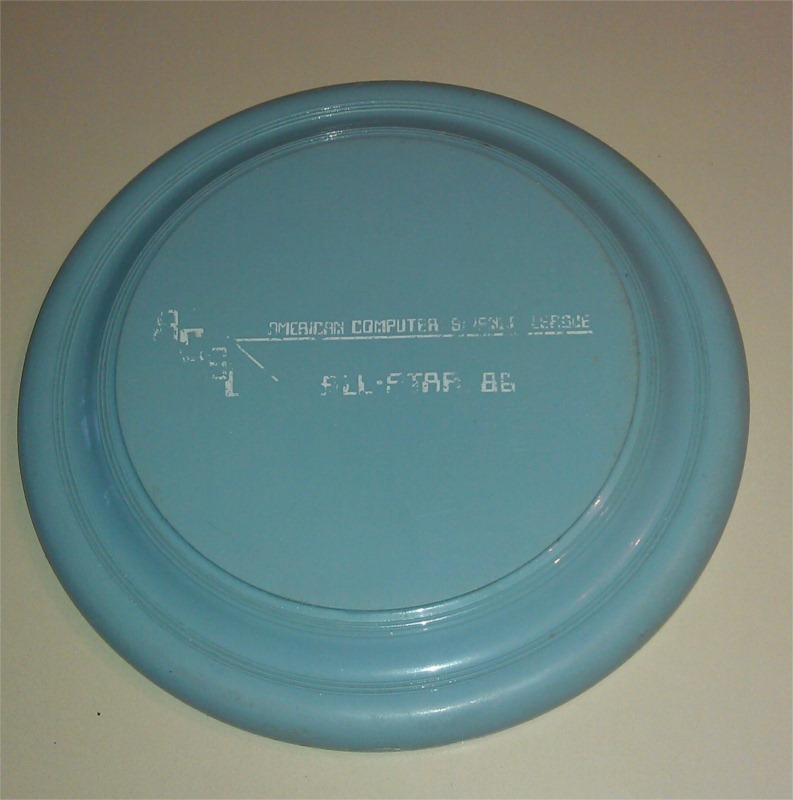
When I was in grade 12 (this would be the spring of 1986), a few of us were asked by our computer science teacher Miss Gray if we wanted to participate in a programming contest run by the American Computer Science League. We would be given a few questions, and we’d have a limited amount of time to write programs to answer the questions. This sounded like fun, so we entered and did really well – well enough to garner a trip to the finals. And not just the Canadian finals, this was for high school students across Canada and the US. (Actually, another guy that went, Faisal, reminded me that we didn’t actually make the finals, but some other team wasn’t able to make the trip so we took their place.) The finals were held in, you guessed it, Elizabethtown, Pennsylvania. Five of us were chosen to go: me, Faisal, Glen M., Glen F., and Paul. Miss Gray and our school principal Mr. Peleschak came too.

Mr. Peleschak was an interesting guy. He was the principal of the school for our entire five years there. He was an older gentleman, very friendly, almost grandfatherly. He had a full grey beard and always wore a smile. Back in the politically incorrect past, every school day began with a recording of O Canada followed by the Lord’s Prayer. (I remember being a defiant atheist and not bowing my head during the prayer. I was such a rebel.) There were numerous different recordings of the Lord’s Prayer, all done by Mr. Peleschak himself, and all different in some way. For example, in some he said “forgive us our trespasses”, others had “forgive us our sins”, and still others had “forgive us our debts”. His various forms of prayer earned him the nickname “The Pope”. Note that this was not a Catholic school.

We all drove down in Mr. Peleschak’s van, and I think I remember more about the trip down and back than the contest itself. iPods were still 15 years away, so a few of us brought tapes and Walkmans (Walkmen?) to listen to music. Mr. Peleschak said he would put our tapes in the van’s tape player so we could all listen, but we’d have to alternate – one of our tapes, then one of his. This was OK with us, except that all of his were John Denver. I wasn’t much of a John Denver fan at the time and after that trip, I’m still not. But I don’t think Mr. Peleschak was much of a Triumph or Van Halen fan, so I guess we were all even. Mr. Peleschak also smoked a pipe, so now and again the van was filled with pipe smoke (though I believe he opened a window when he lit it). Certainly by the end of the drive I was sick of the smell, but I did have to admit it was better than cigar or cigarette smoke.

The contest was being held at Elizabethtown College, and all the competitors stayed in residences there. Faisal and I were in one room (foreshadowing our time at the University of Waterloo, when we were roommates or housemates for almost four years), the two Glens were in another, and Paul was the lucky one who got to bunk with Mr. Peleschak. Miss Gray got her own room. I have no memory of what we did for food, or even how many nights we were there. Everyone got a welcome package, though the only thing I remember it including was a baby blue frisbee with “American Computer Science League” on it. Outside the residence where we were staying was a large open area. I don’t remember if it was a football field or just a big green space but much of the time we were there, there were blue frisbees flying all over the place. Twenty-seven years later, I still have mine (pictured above). The words have faded a little, but it’s still functional. It takes a lot to break a frisbee, when you think about it.

The contest itself was a complete disaster for our team. Each team could request the types of computers they needed, and we asked for Commodore PETs, which were the computers we were using at school. When we arrived, we found that they had provided us with the right machines though an older model. But the problem was that they had a different language installed. The machines shipped with a version of the BASIC language, but our school computers were using Waterloo Structured BASIC**, which was BASIC with extra stuff added. We were forced to adapt to using regular BASIC, and while not a huge disadvantage, it was certainly frustrating and distracting. I don’t remember where we finished exactly, but I have a feeling we might have had full solutions for one or maybe two of the five questions, and partial solutions for the rest. And I think “partial solution” is pretty generous. In short, we got smoked.

The way home should have been memorable, since we stopped at Hersheypark in nearby Hershey for a day of fun. But the only thing I remember about that part of the trip were the street lights in town (shaped like Hershey Kisses) and the fact that many of the street names were chocolate-related. I have no memories of the park itself, though apparently we played mini-golf, since Miss Gray wrote something in my grade 12 yearbook about that.

About a year and a half after this contest, I began my studies at the University of Waterloo, though I didn’t choose computer science as a major until second year. I guess my next computer-related trip was to Seattle in 1991 to work at Microsoft. That trip was pretty memorable as well, but you always remember your first.


* – That was just a joke, really. I have no negative memories of Elizabethtown itself, though we made fun of the place while we were there because it was so small. We lived in a town of about 50,000 just outside of Toronto, a city of 4 million. Elizabethtown had a few thousand people and wasn’t close to anything big. At one point we saw three people walking together and Faisal said “hey look, an Elizabethtown gang!”

** – This ended up being an interesting coincidence years later. Waterloo Structured Basic was developed by a company called Waterloo Computing Systems, which later renamed itself WATCOM. In 1994, WATCOM was acquired by Powersoft, and a year later Powersoft was acquired by Sybase. I started working for Sybase, in the same office where WATCOM was located and with many of the same people, in 1997. We’ve moved buildings but I’m still there, and some of the people who were on the languages team in the ’80s are also still there though many have moved on and some have retired.